
From the Sensex pack, Tata Consultancy Services, Reliance Industries, NTPC, Bharti Airtel, Power Grid, Larsen & Toubro, HDFC Bank, Kotak Mahindra Bank, Tech Mahindra and HDFC were the major laggards. Maruti, Tata Motors, Titan, UltraTech Cement, Bajaj Finserv, Mahindra & Mahindra, State Bank of India and IndusInd Bank were the biggest gainers.

'The conspiracy is to end India's entrepreneurship culture even before it fully blooms.' 'Negativity is being spread in society towards all those who do business, and this hatred for business and wealth creators is spilling everywhere.'

The government has revised gold import data, bringing down numbers for November by $5 billion to $9.84 billion, possibly to rectify double accounting of inbound shipments. According to revised data of the commerce ministry arm Directorate General of Commercial Intelligence and Statistics (DGCIS), gold import numbers have been slashed since April 2024, revealing excess imports of about $11.7 billion during the first eight months of 2024-25.

Social media platform Meta has appointed Vikas Purohit as Director of Global Business Group in India to lead the strategy and delivery of the charter that is focused on the country's leading advertisers and agency partners, the company said on Monday. Purohit will report to Arun Srinivas, director and head of ads business for Meta in India, it said in a statement. "I am thrilled to welcome Vikas as he joins our team to shape the role that Meta platforms can play in enabling businesses, supporting India's economic growth, and building the digital advertising ecosystem of the country," Srinivas said.
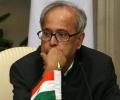
The President noted that the green shoots of recovery were already visible, with the economy growing at 5.7 per cent during the first quarter of current fiscal.

The outcome of the Union Budget, quarterly earnings from corporates and global trends are the major factors to drive stock market sentiments this week, analysts said. Besides, the trading activity of foreign investors, the rupee-dollar trend and the movement of global oil benchmark Brent crude are also crucial aspects to watch out for.
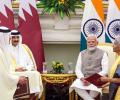
India and Qatar on Tuesday agreed to elevate their relationship to a strategic partnership and double bilateral trade to USD 28 billion over the next five years. Prime Minister Narendra Modi and Qatari Amir Sheikh Tamim Bin Hamad Al-Thani signed agreements and MoUs to strengthen economic cooperation, including a revised double taxation avoidance agreement. The strategic partnership will cover the "entire spectrum" of the bilateral relationship, including trade, energy security, and regional and international cooperation. Both leaders also discussed ways to further strengthen and broaden the energy partnership, including "exploring mutual investments." The Amir's visit provided an "excellent opportunity" for the top leadership of the two countries to discuss and "cement a strategic partnership for enhanced future cooperation."

Economist Deepak Nayyar says economic openness, while necessary, is not sufficient, and is conducive to development only when combined with industrial policy.
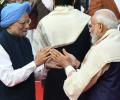
False and acrimonious debates such as Modi versus Manmohan might allow for victories that are political and partisan. But the real loser is the nation, India and Bharat, notes Arvind Subramanian, former chief economic advisor to the Modi government in its first term.

Economic Advisory Council to the Prime Minister has identified ten themes, including economic growth and job creations that need attention.

The United Kingdom extracted USD 64.82 trillion from India over a century of colonialism between 1765 and 1900 and USD 33.8 trillion of this went to the richest 10 per cent -- enough money to carpet London in notes of 50 British pound almost four times over.

'Investment creates capacity and reduces inflation. Income, employment, and savings rise.'

Argentina, Egypt, Ethiopia, Iran, Saudi Arabia and the United Arab Emirates have been invited to join the grouping.
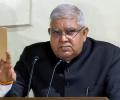
Vice President Jagdeep Dhankhar on Thursday said "dangers are emanating from outfits", including some foreign universities, doubling up as centres of subversive anti-India activities out to demolish the country's civilisation ethos and sully and muddy its growth.

Foreign portfolio investors (FPIs) have net sold domestic shares worth over $10 billion so far this month amid a shift to China, which not only offers attractive valuations compared to India but has also announced several measures to support the economy and the stock market in recent weeks. If the trend doesn't reverse, this will be the first time that overseas funds will yank out more than $10 billion from Indian equity markets in a month.
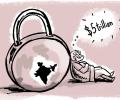
It would be a difficult task for the Indian economy to reach the $5-trillion mark a year before the International Monetary Fund (IMF) projection of 2026-27. Pankaj Chaudhary, minister of state for finance, said in the Rajya Sabha on Tuesday that the government is taking steps to make the country a $5-trillion economy at a date earlier than the IMF's projection. In that context, it would not be difficult to meet the projection in the third quarter of FY27.

'The Budget needs to focus more on social welfare schemes.'

FY17 GDP growth faces cash crunch heat

'Many do not have robust business models, and their prospects of survival and long-term growth are poor.'

'India is still a cash economy.' 'For a common household, almost everything from grocery to maid services is paid in cash.' 'The demonetised notes account for 85 per cent of the currency in circulation.' 'Until fresh notes flow back into the economy, day-to-day transactions ordinarily done in cash will be impacted.'

Fast-moving consumer goods (FMCG) companies anticipate sustained volume pressures in the January-March quarter (Q4) coupled with sluggish rural growth during the period. Brokerages estimate top-line growth to be in low single digits in the quarter. Also, the late onset of winter had an impact on demand for winter products which range from moisturisers to hot beverages.
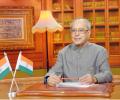
'If the institutions of democracy are under pressure, it is time for serious thinking by the people and their parties. The correctives must come from within.'

India's macroeconomic situation is certainly better than what it was a year ago, eminent economist Pinaki Chakraborty said on Monday, while expressing hope that the country will be back on the path of economic growth if there is no major third wave of the COVID-19 pandemic. In an interview with PTI, Chakraborty, who is the director of the National Institute of Public Finance and Policy (NIPFP), said that inflation may remain at an elevated level as there was a significant fiscal and monetary expansion in the last 18 months. "The current macroeconomic situation is certainly much better than what it was one year back. We are seeing recovery in most sectors," he said. Chakraborty noted that COVID-19 vaccination has been going on at a very fast rate in India.

In the first eight months of 2019, 70 per cent stocks in the BSE 500 universe were down. These stocks account for 94 per cent of India's total market capitalisation.

From the Sensex pack, Infosys jumped the most by 3.67 per cent. Asian Paints, HCL Technologies, Reliance Industries, ICICI Bank, Wipro, NTPC, Tech Mahindra, Bajaj Finserv and Larsen & Toubro were among the other major gainers. State Bank of India, Bajaj Finance, Titan, Tata Steel, Tata Motors and UltraTech Cement were among the laggards.
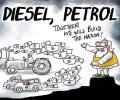
Petrol and diesel sales in the country fell in July over the previous month as the onset of monsoon chipped away demand in some sectors and restricted mobility, preliminary industry data showed. Diesel, the most widely used fuel in the country, saw consumption drop 13.1 per cent to 6.44 million tonnes from 7.39 million tonnes of demand in June. The arrival and intensity of monsoon weigh heavily on diesel demand in the country and consumption traditionally is lower in July-September than in April-June.

'Historically, the markets tend to perform well during election years as governments aim to increase spending and call attention to growth.'

The landmark Air India-Boeing deal will create up to 1 million jobs across 44 states in the US and will further deepen bilateral ties, President Joe Biden has told Prime Minister Narendra Modi. Boeing and Air India announced a mega deal on Tuesday under which the Tata Group-owned airline will purchase 190 B737 MAX, 20 B787, and 10 B777X for a total of 220 firm orders valued at $34 billion at list price. The deal will also include customer options for an additional 50 Boeing 737 MAX and 20 Boeing 787, totalling 290 airplanes for a total of $45.9 billion at the list price.

How do we get back to higher trend growth? The heart of the problem lies in private corporate investment, recommends Ajay Shah.

Will allowing business correspondents to hawk insurance products help in reviving 5-lakh strong field agents as a viable channel?

Most mainstream researchers agree that good governance is a necessary condition for growth.

'Continue with your SIPs to get the benefit of lower average prices in this challenging market environment.'

Chinese state media on Wednesday said Prime Minister Narendra Modi's economic reforms have achieved "little progress" and asserted that the Chinese economy was five times bigger than the Indian economy.
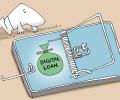
'Banks may find small ticket size lending economically unviable due to the cost of branch operations.'
As US President Joe Biden launched a new trade deal with 12 Indo-Pacific nations, including India, to enhance trade, economic and investment opportunities, China, which sees the pact as a threat to its dominance in the region, went on the offensive against it, promising more opening up, while the official media here termed it as "economic Nato".

'But the world would be much poorer without economics' contribution to understanding how societies function and without economists' suggestions as to how politicians might improve them. 'And economists themselves could do wonders by simply incorporating the country-specific factors in their econometric models rather than just applying them in toto," say Soumya Kanti Ghosh and Samir K Jha.

Asian Paints dropped the most by 1.33 per cent. IndusInd bank fell 1.2 per cent, Axis Bank by 1.19 per cent, SBI by 1.12 per cent, Bajaj Finance by 1.07 per cent, Nestle by 1.04 per cent, and TCS by 0.97 per cent. Hindustan Unilever, Reliance Industries, Power Grid and Kotak Bank also retreated. Maruti Suzuki was the lead gainer, rising by 2.22 per cent.

From the Sensex pack, NTPC, Bajaj Finance, IndusInd Bank, UltraTech Cement, Bajaj Finserv, State Bank of India, Tata Motors, ITC, Power Grid and Larsen & Toubro were the biggest gainers. IndusInd Bank climbed 2 per cent after the company on Tuesday reported a 30 per cent jump in consolidated net profit in April-June quarter at Rs 2,124.50 crore, helped by core income growth and lower bad loan provisions.

Domestic institutional investors pumped Rs 2.3 trillion into equities during H1 CY24. Of this, mutual funds contributed 80%.

Tata Steel was the top gainer in the Sensex pack, rallying 3.23 per cent, followed by SBI, Yes Bank, Hero MotoCorp, ICICI Bank and Bharti Airtel.
